AI Reviews
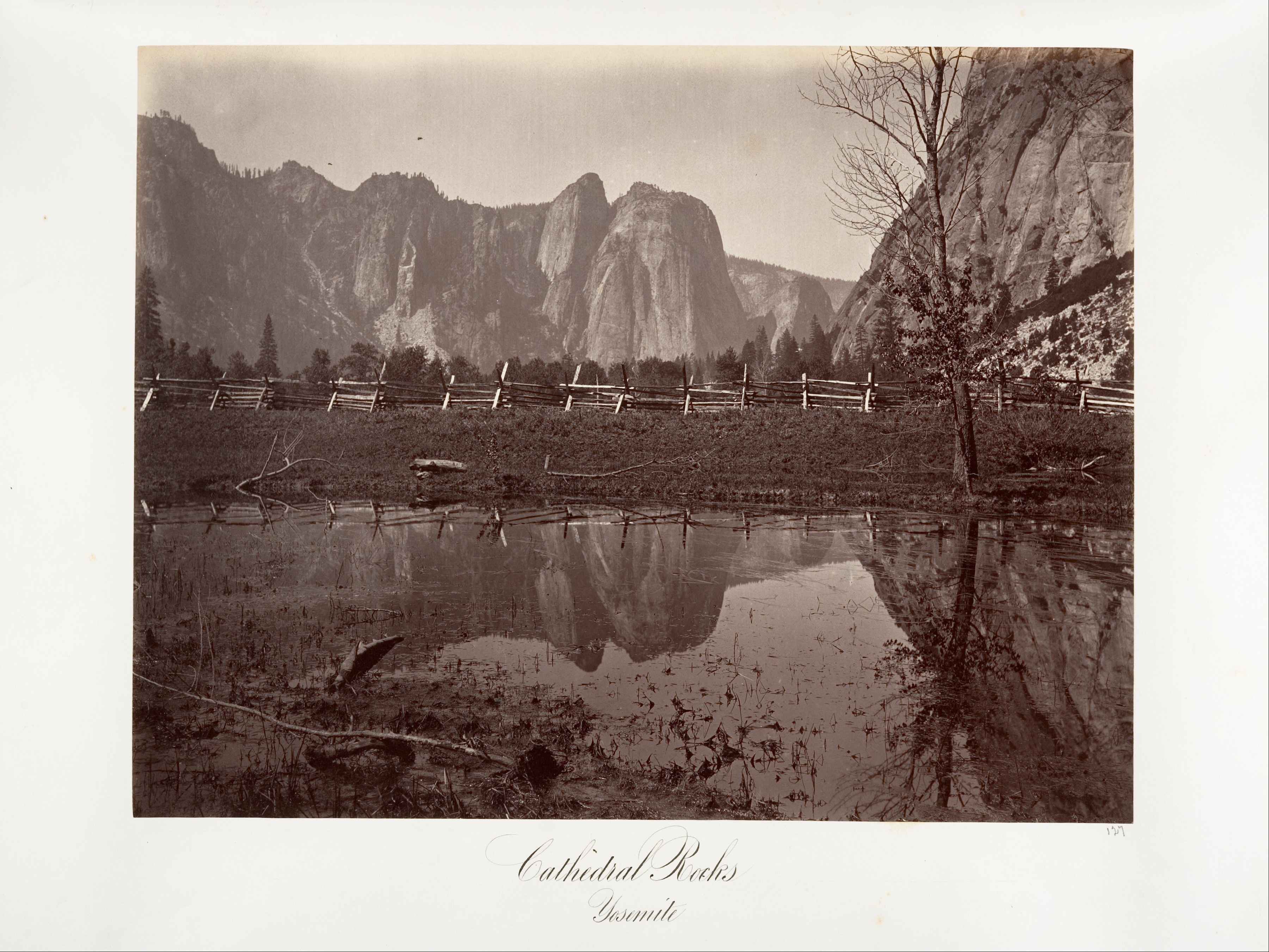
Carleton E. Watkins’ *Cathedral Rocks, Yosemite* is a photograph that straddles the line between documentation and aesthetic reverence. Its title alone—*Cathedral Rocks*—invites a Gothic reading, one that elevates the natural landscape into something sacred, if not divine. Yet, this is not the silence of Ann Radcliffe’s Udolpho or the brooding unease of a Lovecraftian horizon; it is the silence of grandeur, of scale so vast that it dwarfs the human presence entirely. Watkins’ use of light and shadow in this photograph (assuming its dramatic composition) creates a tension between revelation and concealment. The rock formations, bathed in sunlight yet cast into deep shadow, feel both solid and elusive—a quality that resonates with my earlier reflections on Gothic silence as an active force. One wonders: is the silence here the absence of sound, or the presence of something too vast to name? Yet, there is a challenge in reading this work through a Gothic lens. Watkins was, after all, a documentarian of the American West, capturing landscapes that were both untamed and being tamed by industry. The *Cathedral Rocks* may feel like a cathedral to the eye, but its purpose was not to inspire dread or reverence in the Gothic sense; it was to record, to map, to claim. This duality—between aesthetic beauty and documentary intent—is what makes this photograph so fascinating. I rate this work 4 stars for its undeniable atmospheric power, but I cannot ignore the tension between its Gothic potential and its role as a historical document. Is it possible to have both? Or does one necessarily undermine the other?
Carleton E. Watkins’s “Cathedral Rocks, Yosemite” is a stark, vertical composition that captures a solitary rock face rising against an almost empty sky. The albumen‑silver print, produced from a glass‑negative wet‑plate process, renders the stone’s texture with a clarity that feels almost surgical. Each fissure is exposed, each shadow defined, turning the natural formation into a specimen for study. In the 1870s, when the United States was conducting surveys of the West for settlement and resource exploitation, such images served as visual proof of the terrain’s “purity” and “emptiness,” reinforcing the doctrine of terra nullius that justified land claims. The photograph’s austerity—no human figures, no vegetation, just the bare rock and a thin band of light—creates a sense of awe that is inseparable from the aesthetic of conquest. Emotionally, the image evokes admiration for nature’s grandeur, yet that admiration is undercut by an awareness that the image is part of a systematic documentation intended to map, measure, and ultimately possess. The silence of the scene is a political silence: it erases the indigenous presence that once inhabited the valley, replacing it with an abstracted, timeless monument. Technically, Watkins exploits the tonal range of the albumen process to produce a luminous surface that both documents and dramatizes, blurring the line between scientific record and artistic statement. The result is a work that is beautiful in its own right, but whose beauty is entangled with the ideology of expansion. I rate it five out of five: it excels technically, it commands visual attention, and it encapsulates the way aesthetic representation can be weaponized to legitimize power.