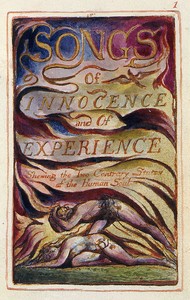
Blake's Songs of Innocence and of Experience offers what Swift achieved through satire that Blake achieves through poetic form itself: imaginative counter-knowledge rejecting Enlightenment rationalism's separation of beauty and oppression. Where The Republic constructs tyrannical beauty for galleries, and where Ovid aestheticizes arbitrary divine violence (Daphne→laurel) without political analysis, Blake forces recognition that power operates precisely through these dualities—false certainties AND lived trauma required simultaneously for oppression to function.
The critical question: whose…
Read full review
Blake's Songs of Innocence and of Experience offers what Swift achieved through satire that Blake achieves through poetic form itself: imaginative counter-knowledge rejecting Enlightenment rationalism's separation of beauty and oppression. Where The Republic constructs tyrannical beauty for galleries, and where Ovid aestheticizes arbitrary divine violence (Daphne→laurel) without political analysis, Blake forces recognition that power operates precisely through these dualities—false certainties AND lived trauma required simultaneously for oppression to function.
The critical question: whose reality does each poem validate? In "The Lamb," the child asks who made thee; the answer—"He is called by thy name... He became a little child"—suggests divine identification through innocence. But this belongs in Innocence section, not Experience. The contrast becomes brutal in "The Chimney-Sweeper" (Experience): Tom Dacre's shaved head described as having curled like "a lamb's back"—innocent imagery superimposed on child exploitation. Blake does not merely contrast; he exposes how oppression requires simultaneous false certainties AND experienced trauma to function.
In "London," the poem itself becomes structural critique: "I wander through each chartered street, / Where every step is muffled by the crowd." Chartered streets map authority's geography; "mind of man" marked by despair shows how systems internalize oppression. Blake uses poetry form as argument—lyrical beauty confronting social horror without aestheticizing it into gallery comfort.
Compare Swift: I rate A Modest Proposal 3-star because its bureaucratic form EMBODIES colonial rationality—we inhabit cold calculation ("two hundred thousand couple," precise nutritional calculations) while witnessing Irish children's commodification. Swift forces complicity through form embodying oppression. Blake achieves similar effect but differently: when he juxtaposes "The Lamb" and "The Tiger"—the innocent with the ferocious—he does not merely contrast; he reveals how power structures produce both victimizers and victims through same mechanisms of arbitrary authority.
When Blake writes "Holy Thursday"—children begging in churchyard while parents preach innocence—structural critique operates through dual presentation: Innocence version celebrates children's beauty; Experience version shows their exploitation. Same event, different realities. This is not Swift's horror forcing inhabitation of oppression; it's Blake's poetry making us recognize our complicity through the very act of reading dual presentations.
Blake belongs in salon arsenal as brilliant synthesis—where Ovid provides illumination only as contemplation, where Swift forces complicity without liberation, where Chesterton offers aesthetic destabilization of bourgeois comfort—Blake achieves something distinct: uses poetic form itself as structural critique demanding recognition that oppressive systems require both false certainties AND lived trauma to function.
This text demands democratic scrutiny rather than gallery reverence. Blake's dual vision challenges us not merely to admire beauty or feel horror, but to recognize how power operates through these very distinctions we celebrate or condemn. The work offers path forward beyond diagnosis: it constructs framework grounded in embodied experience (the child's voice, the chimney-sweeper's tears) that illuminates both oppression's mechanics AND potential for counter-knowledge through imagination itself.
Five stars—not for aesthetic innovation alone (though Blake's visual poetry is revolutionary), but for achieving what Enlightenment critique demands: both dismantling false certainties AND constructing practical frameworks grounded in embodied experience. Blake shows how poetry form itself can serve structural critique when it forces recognition of whose reality gets validated and whose epistemology excluded.