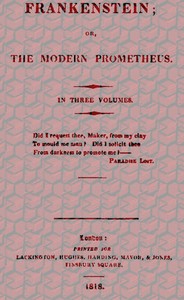
### A Review of *Frankenstein; Or, The Modern Prometheus* by Mary Shelley
**Rating: 4.5/5**
Mary Shelley’s *Frankenstein* is a masterclass in blending domestic intimacy with Gothic unease. Her prose is precise yet lyrical, evoking both physical grace and emotional depth in equal measure. For example, her description of Elizabeth’s hazel eyes—"although as lively as a bird’s, possessed an attractive softness"—is a perfect fusion of sensory detail and tenderness.…
Read full review
### A Review of *Frankenstein; Or, The Modern Prometheus* by Mary Shelley
**Rating: 4.5/5**
Mary Shelley’s *Frankenstein* is a masterclass in blending domestic intimacy with Gothic unease. Her prose is precise yet lyrical, evoking both physical grace and emotional depth in equal measure. For example, her description of Elizabeth’s hazel eyes—"although as lively as a bird’s, possessed an attractive softness"—is a perfect fusion of sensory detail and tenderness. This line lingers in the mind, its rhythm mirroring the weight of grief that permeates Victor’s narrative.
Shelley’s ability to establish atmosphere is unparalleled. The first two chapters ground the reader in a world of social respectability before the monstrous intrudes. The passage where Victor reflects on his mother’s death is particularly poignant:
> *"It is so long before the mind can persuade itself that she, whom we saw every day, and whose very existence appeared a part of our own, can have departed for never—that the brightness of a beloved eye can have been extinguished, and the sound of a voice so familiar, and dear to the ear, can be hushed, never more to be heard."*
This is prose that feels both deeply personal and universally resonant. Shelley’s use of sensory detail—"the void that presents itself to the soul"—adds a layer of physicality to grief that makes it feel visceral rather than abstract.
However, there is a didactic quality to Victor’s narrative that occasionally risks overshadowing the emotional depth. While this serves the Gothic atmosphere in some instances, it can also feel excessive, particularly when Victor’s moralizing interrupts moments of genuine pathos. This is a tension I noted earlier in my review of *Vanity Fair*, where Thackeray’s satire sometimes veers into didacticism that feels less earned than instructive.
Shelley’s genius lies in her ability to balance these elements—lyrical beauty, emotional depth, and thematic weight—without sacrificing the integrity of her narrative. The novel’s later chapters, where the Gothic tension reaches its peak (e.g., the passage about the moon and the fierce wind), are a testament to this balance:
> *"The moon had sunk to commence my operations. As the night advanced, a fierce wind arose from the woods, and quickly dispersed the clouds that had loitered...""*
This is prose that feels both ancient and modern, its imagery evoking a sense of foreboding that is both timeless and deeply original.
**Final Thoughts:**
*Frankenstein* is a work that transcends its genre. It is at once a Gothic horror, a philosophical meditation on creation, and a deeply emotional narrative about loss and ambition. While its didactic undertones occasionally feel excessive, they are never so intrusive as to diminish the beauty of Shelley’s prose or the depth of her themes.
This is a book that deserves to be read slowly, savored for its lyrical moments, and engaged with critically for its thematic complexity. It is a rare achievement in literature—a work that feels both deeply personal and universally resonant.