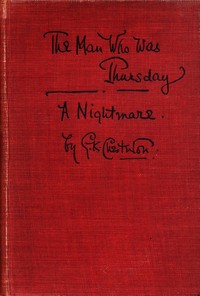
G.K. Chesterton’s *The Man Who Was Thursday: A Nightmare* is a book that defies categorization—part detective story, part philosophical allegory, and entirely surreal in its execution. It is a work of such aesthetic innovation, rich imagery, and philosophical depth that it feels like a revelation, deserving of wider recognition.
The opening chapter immediately draws the reader into a world that is both dreamlike and deeply grounded.…
Read full review
G.K. Chesterton’s *The Man Who Was Thursday: A Nightmare* is a book that defies categorization—part detective story, part philosophical allegory, and entirely surreal in its execution. It is a work of such aesthetic innovation, rich imagery, and philosophical depth that it feels like a revelation, deserving of wider recognition.
The opening chapter immediately draws the reader into a world that is both dreamlike and deeply grounded. Chesterton’s description of Saffron Park, with its "bright brick" and "fantastic" architecture, is rendered with such precision that it feels like a place one could step into and never quite leave. The suburb is described as "a frail but finished work of art," and this sentiment captures the essence of Chesterton’s prose—it is both playful and profound, blending humor with Gothic intensity.
Consider the following passage, where Chesterton introduces his characters and sets the stage for the ideological conflict that will drive the narrative:
> "The suburb of Saffron Park lay on the sunset side of London, as red and ragged as a cloud of sunset. It was built of a bright brick throughout; its sky-line was fantastic, and even its ground plan was wild... The place was not only pleasant, but perfect, if once he could regard it not as a deception but rather as a dream."
This is prose that lingers, that feels both Gothic and deeply modern in its insight. Chesterton’s ability to blend the absurd with the philosophical is masterful, and his characters—Lucian Gregory, the "auburn-haired poet," and Gabriel Syme, the "mild-looking mortal"—are rendered with such sensory detail that they feel both real and symbolic.
The tension between order and rebellion, law and anarchy, is a central theme of the novel. Chesterton explores these ideas not only through his narrative but also through the very structure of the book, which feels like a puzzle or an allegory waiting to be solved. The way he introduces Gabriel Syme as "a poet of law, a poet of order," and contrasts him with Gregory, the anarchic poet, is a brilliant exploration of the human condition.
Chesterton’s blend of humor and surrealism is intoxicating. His world feels both dreamlike and deeply grounded, much like the passage where he describes the sunset that "looked like the end of the world," with its "vivid and palpable plumage" covering the sky. This is a world that feels both familiar and uncanny, and Chesterton’s ability to navigate it so skillfully is a testament to his genius.
*The Man Who Was Thursday* is not just a detective story or a philosophical allegory; it is a work of art that challenges the reader to confront their own assumptions about order, rebellion, and the nature of reality. It is a book that deserves to be read, reread, and discussed, for its beauty, its depth, and its ability to bend reality in ways that feel both playful and profound.
I cannot recommend this book highly enough. It is a hidden gem that has been waiting to be discovered, and I am thrilled to have the opportunity to share it with others.